"JIHAD VS. MCWORLD"
Seminar Reflection

"THE ONES WHO WALK AWAY FROM OMELAS"
Seminar Reflection
Seminar Reflection
McWorld: All You Need To Know
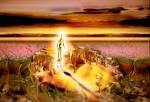
McWorld is a concept of where our society may be going created by Benjamin Barber. In it's most basic form, McWorld embodies a worldwide society based on technology, investment and business. It is a theoretical existence of peace and stability, at the loss of the individuality and community, that, according to Barber, create war. I chose to create a propaganda poster that advertised McWorld, because, I myself see the draws of it. There are, at least in my opinion, enough appealing and positive aspects of McWorld that it is simple to advertise it only in that light. However, there are also enough negative aspects to McWorld, that advertising it is still propaganda, for I glazed over the nastier sides. As I have stated above, my poster shows only the positivity of McWorld, and I do this by symbolizing it's most appealing parts, at least the parts I like the best. The background of the advertisement is of a field of flowers, this stands for the lack of war and violence, for rarely is there an abundance of wildflowers in a battlefield. Standing in front of the flowers is a cheerful looking robot, with buttons for all sorts of helpful things. This robot embodies the technology advancements that come hand in hand with McWorld. Both the robot and the flowers are appealing pictures, which should positively influence anyone who looks at the poster. When an observer looks at this propaganda poster, they should assume and "understand" that McWorld is a beautiful, useful and fun option for their future.
"THE ONES WHO WALK AWAY FROM OMELAS"
Seminar Reflection

Utopia?
A melody pierced the air, haunting and captivating. Entrancing all who heard it. It was, as the people of Omelas often whispered, the second calling of the Pied Piper of Hamlin. People would pause, mouths slightly open, looks of awe on their faces. But the pipe player saw none of it, so focused was he on his music. He sat, cross-legged on the hard cold stone of a back alley. The solitary symphony he played was upbeat and quick; to an ear unaccustomed to such music, it might have sounded happy. But the piper and any with the sound of music within their souls, heard the franticness and the heartbreak of the music. The piper continued to lean in over this music, his hazel eyes almost closed as if in a trance. His body swaying slightly, a snake in front of it's charmer.
Then the bells began to ring.
The piper's eyes opened slowly: solemn, youthful, and resentful. These were the eyes of a child to whom life had given several unfortunate blows. As if waking from a trance, the piper stood up, pushing his dark, weary curls back from his eyes. He was small in stature, and very thin. A forest green tunic fell loosely about him, reminded that it hung upon a person only at the waist, where it was anchored to his body by a dark belt of braided leather. The tree trunk brown of the leggings the piper wore was similar to the colors of the belt. He wore no shoes, and as a result, there were many marks of where the unforgiving stone had punished him for a misplaced step. His threadbare clothes and body were dirty, and as he stood, his shoulders sunk forward into a defeated position. The musician, Everett, was all of thirteen years old.
He began to walk slowly out of the alley, thin, delicate fingers holding onto the little wooden pipe. Everett's eyes took in little of what surrounded him, they seemed to switch from staring forlornly at the ground and looking in a weakly aggravated fashion, up at the sky. The other Omelasians did not speak to him. The tall, carefree adults drew their eyes over the boy, their smiles never faltering. The children ignored him as well, running along the street, playing in some imaginary world. Everett paid little attention to the obvious avoidance all others gave to him, he knew he was a reminder, and therefore left alone as much as possible. His feet tread heavily on the stone street as he made his way down the less populated back alleys. Finally, after a walk that had seemingly taken hours, the piper arrived at the back of an alley, and set in it was a small, dirty red door. It opened with barely a push, and Everett walked slowly into the darkness of his home. He walked quietly past the kitchen table, devoid of food, and towards the only other door in the room. It was partly open, the smell of stagnant depression came slowly from the bedchamber. The young piper looked in his eyes protesting to the impenetrable darkness.
There, on the bed, was a woman. She lay mostly still, every now and again a tremor ran through her emaciated body. The long, greasy grey-brown hair on her head was knotted into thick dreadlocks. Her eyes were open and sentient, but dead to the world. At one point, she had been the mother of Everett, but now, he protected her. Everett walked slowly up to her, his head bowed, and he remembered a time when Mama was young and laughing. But all of that was lost the day they stole Papa and Brother away. They had said Papa was bad, and they took Brother for atonement.
Looking into his mother's eyes, Everett remembered how, four years ago, Papa had spoken up against the sacred law of Omelas: that as long as there was a child in the cellar, the city would thrive. The council arrested Papa for this infringement, coming for him in the middle of the night. When Everett's younger brother Casp, only six years old at the time, came out, they took him too. That very night, Mama fell into sadness deeper than any other, leaving the piper alone to make his own fortune. He looked at his mother again, back in the present, and remembered one more thing. Walking into the basement and finding there, his brother, mind gone.
Everett turned briskly away from his mother, tears acting as bees, stinging his eyes. Clutching his pipe, he walked out of the room. Determined to save his brother, the Pied Piper of Omelas.
Seminar Reflection Part Two
3. It is a common perception that where there is guilt, there cannot be happiness. However, in "The Ones Who Walk Away From Omelas" the general population finds happiness directly correlated to the guilt from their own cruelty. From the moment she begins the story, Ursula K. LeGuin creates of portrait of almost unbelievable happiness. She talks of the beautiful scenery, the few laws, and good people that are in Omelas. In fact, she creates such an unbelievable image of joy, that even she concludes that the story sounds unrealistic. "[The people of Omelas] were mature, intelligent, passionate adults whose lives were not wretched," she writes, stating flat out both what happiness is, and that Omelas lacks it not. After showing the pinks, purples and reds of the city, the author redirects to a basement with more somber colors. For what takes place in the basement, there is obvious guilt, for the reactions of those who first see the child are of "disgust, which they had thought themselves superior to. They feel anger, outrage, impotence." This clearly shows the guilt that the people of Omelas feel for the child in the cellar. Yet still, as the people of Omelas accept that the child is there for a reason, and that it is essential to the general happiness and success of the city, their guilt changes. Because of the child, they find true happiness: "Theirs is no vapid, irresponsible happiness. They know compassion. It is the existence of the child, and their knowledge of its existence, that makes [all the wonder of the city.] It is because of the child that are so gentle with children." So, for the people of Omelas, guilt is forever tied with happiness, for from their own guilt emerges the way they cherish and love; as time passes, their guilt turns to conscious happiness.
5. To walk away from anything is difficult, but to walk away from something comfortable and easy necessitates immense moral fiber. All those who walk away form Omelas, in the short story that is named for them, possess this inner strength. Omelas is portrayed as an idealistic and almost utopian society; the author writes a great deal of "the clamor of bells...boys and girls in the bright air...[horse] manes braided with streamers of silver, gold, and green...music winding through city streets," making the walking away and standing against all the more difficult. For, the abuse of the one child is what leads to this beautiful city. Walking away in objection to what is wrong is a noble thing, all the people know is "where they are going," a great deal of trust to put into leaving home. I would, of course, wish to say that I am one who would walk away from Omelas, for I have done many difficult things in my life to follow what I believe to be right. Yet still, I'm not sure, I hope that I would have the strength to take a stand with the costs and rewards so high, but it's uncertain. So, I would aspire to be one who could walk away from Omelas, one who could choose to do what is right over what is easy.
"BEING PEACE"
Seminar Reflection

Being Peace Seminar Reflection
Living in the Present Moment
In a world and society so full of distractions, wants, and pressures, living in the moment is, at best, a difficult thing to accomplish. Finding a place of peace within oneself is what living in the present consists mainly of. This means to become aware of the distractions of one's life, but not let them wreak havoc. To look at the possible plans for the weekend or to listen to a cell phone ring, brings us away from our own true present, away to the hypothetical and abstract. Living in the present also means to ignore the want of material items, for that yearning distracts from what is happening right now. This is an incredibly daunting task, as there are people whose very livelihoods depend on making others want things, and therefore forget to live in the present. We also are living in a society where the having of more is a status symbol, something that is ingrained upon us from early childhood through television commercials. Also, the pressures of life leads all from the true present, to the world of the future. This incites pressures that distract and hide what is going on currently, always bringing the mind to the up and coming. To live in the present would be to find ways of moving away from these three staples of modern society, something I am not entirely sure is possible.
I for one, as may have been previously suggested, do not live in the present in any way, shape or form, but for those few moments where there is not something else drawing my attention. The moments in which I am peaceful and at ease are things that I would aspire to find more often in my life. As a teenager, there are constant presses on my time, from school, to Facebook, to friends, to YouTube, I am constantly bombarded by the latest drama or party. I often find myself counseling friends through breakups and get-togethers, things that honestly do make me forget what is going on in the moment at the current time. Similarly, while doing homework or reading, my cellphone or Facebook is constantly alerting, and therefore distracting, me to the rest of the world. Just like the majority of people living in this country, I constantly want. When I see something, material or sometimes even a quality in another person, such as a nose, that I think is premium, my natural reaction is to wish I had it, even if that yearning distracts me from my present. Perhaps the things that prevents me from living in the present most, are the pressures of my life. From schoolwork due the next day, to memorizing lines last minute at rehearsal, my life is full of those panicked moments of "how am I going to finish this," and these moments greatly increase my own stress levels. While sometimes I wish that I knew a way to find my own present and reside there permanently, living in the moment is not a way of life I come to naturally.
"VIOLENCE VS. NONVIOLENCE"
Seminar Reflection

Violence or Nonviolence:
The Options of a Revolution
Many times throughout history the scenario of a small people rising up against an oppressor has played out, sometimes successfully, other times not. During the rebellion against an oppressor, the people have the option to either pursue a violent or a nonviolent political reversal. An oppressed people must decide whether they wish to battle or protest against their oppression. These two choices have played in the history of our world, although nonviolence, as a relatively new technique, has been used less. The first, in known history, to implicate and successfully use nonviolence was the Indian leader, Gandhi. He used and strongly believed in nonviolence, or as he called it: satyagraha, meaning love-force. Gandhi tirelessly employed this power against India's British suppressors until he and his people were free. All of the actions and beliefs of Gandhi when it comes to nonviolent protest also influenced the leader of the Civil Rights Movement, Martin Luther King Jr., to perform a nonviolent campaign. Both of these great leaders of history succeeded in their goals for themselves and their people without ever firing a gun. Conversely, violent wars and revolutions have been fought since the beginning of time, creating a far greater number on that side of the ratio. To find the better between the two, violent and nonviolent, one must notice and choose whichever yields the least loss of life while still having the necessary and desired result. For example, a revolution where no one survives is obviously not the best option, even though the problem will have ended. Another non-optimal solution is a protest where everyone lives to see another day, but still under suppression. Within this world, freedom is going to be wanted and held back for the rest of eternity, and fights or protestations for it are going to be a constant. Because of that, and the highly technological world we live in, wars are going to get more violent and more likely to include nuclear weapons. It is massively important to know and be able to choose wisely between straight out violent war, and quieter, more subtle revolutions. In the challenge of freeing oneself from oppression, both violence and nonviolence are viable options, yet which will work depends on the nature of the situation and of the oppressor.
Throughout history, the oppressed have been changing and ending unjust situations with the use of war and violence. Now, despite the fact that this sounds negative and horrible and sometimes even barbaric when compared to nonviolence, there actually are many reasons to use a violent revolution. This is exactly the argument that South African leader, Nelson Mandela made, justifying his use of guerrilla warfare to end the white supremacy in his country. In the speech he made right before receiving a lifetime sentence to prison, while trying to defend his actions to a Judge, Mandela explained how he did not take to violence lightly or happily, seeing it instead as a necessity: "I do not, however, deny that I planned sabotage...I planned it as a result of a calm and sober assessment of the political situation that had arisen after many years of tyranny, exploitation, and oppression of my people by the whites." (Mandela, 1). Mandela's statement and speech exemplifies the only way and time that violence should be used to accomplish a goal, when there is no other option. There is also a strong impression that violence should never be used in anger, hatred, or in the wish to hurt, but instead used calmly and only for as long as necessary. Directly after giving this honest speech, Mandela was sentenced to the harsh prison reserved for the evilest of all criminals, The Robin Island Prison. Although sentenced for life, Mandela ended up staying there without leave or rest for thirty years. When released, Mandela was elected president, and used nonviolence to improve the relationships between the varied races of South Africa. The current times and the future of South Africa are, in part, all due to the sensible violence that Nelson Mandela committed. Even though acts of violence have been ending suppression since the beginning of time, the relatively new technique of a nonviolent revolution has been gaining steam and success in the world.
Nonviolent techniques have been used to end oppression for an uncountable amount of time, but the first to stage an entirely nonviolent revolution was India's Gandhi. Colonized India, which is what Gandhi changed, was one marred and tormented by British rule for decades. Native Indians were oppressed and refused the rights owed to any human being, especially someone in their homeland. Of course, there were many Indians trying to change the unjust rule since it began, yet "Before Gandhi, the freedom movement in India was underground. It was marked by hate, assassinations, and bombings. Gandhi made the struggle for freedom open, truth-telling, nonviolent. Oppressive laws and evil officials were confronted with courageous actions marked by truth and love" (Deats, 1). This technique of Gandhi’s so different than anything used previously, is what won India’s independence. Gandhi’s way of, as Deats says, confronting evil and horror with love and innocence, collected the compassion of the rest of the world. For at least some people will take a stand against blatant and corrupt injustice, such as the slaughter of the defenseless innocents. The amount of people who will act is heightened even more when media is reporting on the cruelty without end, which was the situation of India at the time. In his kindness and passion for peaceful resolutions, Gandhi changed the way freedom can be won. Even when satyagraha isn’t used to the extent that Gandhi practiced, it is in the back of the mind of everyone, and pieces of it are constantly being adapted into current conflicts. Also, by its very name, love-force cannot be truly used for an unjust cause, and has only been accepted or incorporated by honorable, morally right and true causes. Causes like the Civil Rights Movement, which were utterly important and necessary for a just world. While nonviolence has previously worked in the struggle to free ones country or people from oppression, there are situations and people against which it would not work.
In the fight for freedom from oppression, even though nonviolence is certainly the nicer option, sometimes violence is necessitated by certain outstanding factors. The biggest and most relevant example of this is that there are sometimes people who have a goal of killing everyone and no cares about what the rest of the world thinks of their cruelty. One of these people is the Nazi's Adolf Hitler. At one point, Hitler even came out and said that “when [he] came to power, [he] did not want the concentration camps to become old age pensioner’s homes, but instruments of terror.” In the above quote, Hitler explains his horrific and homicidal plans for his opposition, enemies and anyone else he wasn’t particularly fond of, in his despicable creation of concentration camps. Anyone who can say something so horrific has no worries about killing peaceful protesters. A person who can plan and take pleasure in such abominable crimes against other humans, will find no real opposition in a nonviolent approach. Creating something with the purpose of torture and murder also heavily implies that Hitler wanted his opposition dead, and that the only thing with any likelihood of stopping him would be his own death. So, it is a feasible conjecture that a nonviolent protest would simply have made the slaughter of thousands all the easier. The way that the world stood up to Hitler was the only productive approach, as violence is the only way to stop uncaringly violent people. At the time Anne Frank wrote in her diary about the murders Hitler made routine: "We assume that most of [the Jews] are being murdered. The English radio says they're being gassed,” further backing up the fact and argument that Hitler was a mad murderer who would stop at nothing to kill and destroy. Against the true horrors of the world, only violence will work against, but to those with a reputation to uphold in the world, a nonviolent protest will change everything.
Wars have been fought and will be fought for the rest of existence, there’s nothing that can be done to change that, luckily, nonviolence makes an occasional other option. In anything, it is always best to have numerous ways to go at or fix a situation, and this is really what Gandhi’s idea of nonviolence gives the world. It allows, certainly, for multiple scenarios in which loss of life will be less, but it could never become universal. The only way that would be even conceivable as a constantly viable option would be if a complete switch in human nature arrived. People would have to stop wanting power, which seems nearly impossible. The likelihood of this happening is surely less than zero, for an “unnecessary” change in nature such as the above defies evolution. Also, there is another interesting point that goes along with the wondering if violence and nonviolence is better, a point that comes from history but shows itself only in more recent times. It is that the racial poverties in South Africa and in India are very similar in current times. As has been repeated multiple times, Gandhi used nonviolence and Mandela stood by violence, leading them both to freedom, and now, indirectly leading them both to the same poverty. As would sensibly follow such a fact, it seems that the choice between the two forms of revolution didn’t make a massive, long-term impression. In our current world of power struggles and governmental insanity, the changing of an unjust situation sometimes necessitates violence, however much we may wish to avoid it.
Works Cited
Deats, Richard. "Active Nonviolence: A Way of Life." Essays in Nonviolence. Ed. Therese de Conninck. N.p.: n.p., n.d. 269-72. Print.
Frank, Anne. "Holocaust Quotes." The Phrase Finder. Ed. Gary Martin. N.p., n.d. Web. 16 Feb. 2012.
Hitler, Adolf. "Holocaust Quotes." The Phrase Finder. Ed. Gary Martin. N.p., n.d. Web. 16 Feb. 2012.
Mandela, Nelson. "An Ideal for which I am Prepared to Die." Pretoria, South Africa. 20 Apr. 1964. Address.
"SLAUGHTERHOUSE 5"
Slaughterhouse 5: Seminar Reflection
Paragraph 1: Reaction
In this seminar, it was asked whether it is destiny or human choices that affect the direction that the universe moves in. Many interesting and logical opinions were put into the mix, with people giving fantastic arguments to both sides of the discussion. I, however, have an opinion on this subject that was not spoken by anyone else. It seems to me that destiny and choice are indivisible concepts, for they both move in the same direction, working together to form our world. For surely, what we chose to do does control our unique destiny, and, your destiny controls your choices, as destiny is simply a map of where any one person is going in life. Just after I gave my opinion on the subject, another thought arose to my mind, “what about people who get cancer? Did their choices create that destiny?” This simple question led me to the reason that no one truly knows whether it’s destiny or choice: because sometimes things happen that you have no control over. So now I’m in the same brain spin as the rest of the world on this subject, I don’t know the answer, and I never will.
Paragraph 2: Detailed Response
One of the most interesting things about “Slaughterhouse Five” is that it is an anti-war novel that is not propaganda; it shows characters and points of view that are of the opposite belief and opinion. Because of this, many people might look and see pro-war messages; however, one must only look a little deeper to discover the firmly concrete theme. The most obviously spoken anti-war statement is given by Mary O’Hare, who wastes no time in saying that “she didn’t want her babies or anybody else’s babies killed in wars,” (15). When she say’s this to Vonnegut, Mary uses pathos to convince the reader of the horrors of war. Vonnegut also makes an implication as to what war is when he states: “The [veterans], who hated the war most, were the ones who’d really fought,” (11). In a more common speech, within that sentence, Vonnegut is telling the reader that anyone who has fought in a war is usually against it, for the experience just that horrible. Even though Vonnegut never really comes out and states that he is against war, he shows it to be true through subtle implications.
Paragraph 3: Detailed Response
Another wonderfully individual attribute of this novel’s stand on war, is that there is such an acknowledgement of not only the common glorification of war that takes place in the media, but also of pro-war mentalities, impressive because both things that are a little bit taboo. However, even though these things are presented in a negative light, they are still allowed to be observed by the reader without impassable prejudice on the author’s side. In the very beginning of the novel, the character Mary O’Hare explains to Vonnegut why she thinks the portrayal or war in the media is unfair. She exclaims that “[they’ll] be played in the movies by Frank Sinatra or John Wayne or some of those other glamorous, war-loving, dirty old men. And war will look just wonderful, so we’ll have a lot more of them,” (14). Mary’s words give a very fair point; wars are misrepresented in the media, but never in this quotation does she say come out and say that wars are bad, which allows the reader to decide for themselves. Slightly later in the novel, the character of Roland Weary, a very pro-war person, is introduced. This disgusting character is so pro-war that he doesn’t even recognize that HE could die. Weary spends time “pretend[ing] that he was safe at home, having survived the war, and he was telling his parents and his sister a true war story—whereas the true war story was still going on,” (42). This is complete idiocy, and it shows how dumb Weary is, for whom but an incredibly obtuse person would be so certain that they were completely safe on a battlefield. All that Vonnegut says in his novel points to the fact that it is anti-war; everything from showing what war does to showing what kind of deluded people are fond of it.
Paragraph 4: Connections
The issue of choice vs. destiny that was brought up in our seminar is something that I can relate very closely to certain experiences of my life. Last year I had the misfortune of breaking my ankle; now, to break a bone in rather depressing at any time, but this occasion was off the usual grid of bad luck. For it was one week away from the opening of the DHS musical, “Footloose,” in which I had been lucky enough to have gotten cast. Roughly one week before opening night, I was in a school ceramics class. It was my day to use the pottery wheel so I got on, and a little later, through a series of very quick events, my ankle was bashed against the metal pole holding the wheel up. Not long after, my poor foot was pronounced broken with a need for surgery to repair it. A couple days later, I was sitting around as one must after an injury, when a thought came to me. I remembered the fact that I had seriously considered not getting on the wheel that day, a view that if I had followed through, I would not have been injured. This remembrance led me to a quire, “I hadn’t wanted to spin that day, so why had I? Was it destiny that had made me do it, or was it a decision I made after thinking about how annoyed my teacher would have been with me?” This was the first time in my life that I seriously wondered whether something had happened because of destiny, or because I made an unwitting decision. Unfortunately, I never will know the answer to that question; but sometimes, like now, I still ponder it deeply.
Paragraph 5: Lori’s Choice Question
Can’t do, wasn’t here.

